Best Places to See Northern Lights on a Budget
Look at any luxury travel catalog in the winter, and you will see the exact same image.
A couple lies inside a heated, geodesic glass dome in the middle of a snowy Finnish forest. Outside their ceiling, an ethereal ribbon of bright green light dances across the pitch-black Arctic sky. Champagne chills in an ice bucket beside them.
Then you scroll down and look at the price tag: ₹1,50,000 to ₹2,50,000 per night, excluding flights, thermal gear rentals, and guided snowmobile transfers.
For the average traveler, that single image turns one of the greatest natural wonders on Earth into an impossible luxury dream. You look at your savings account, look at the brochure, and tell yourself, “Maybe one day when I’m wealthy.”
That assumption is completely wrong.
The sky does not charge an admission fee. The Aurora Borealis does not care whether you are sleeping in an ultra-luxury boutique pod or a budget campervan parked next to a frozen fjord.
Finding the Best Places to See Northern Lights is not about how much money you spend on high-end hospitality; it is about understanding atmospheric science, solar cycles, geography, and patience.
If seeing the sky dance with emerald and violet fire is at the top of your life bucket list, here is the complete guide to chasing the lights without destroying your bank account.
Understanding the Solar Phenomenon
Before you book a single flight ticket, you must understand what you are actually traveling to see. You are not booking a theatrical show with a guaranteed start time; you are hunting a collision of cosmic physics.
The Northern Lights occur when charged particles from the sun stream across space on the solar wind and slam into Earth’s magnetic field. Our magnetic shield deflects most of these particles, but channels a fraction toward the magnetic poles.
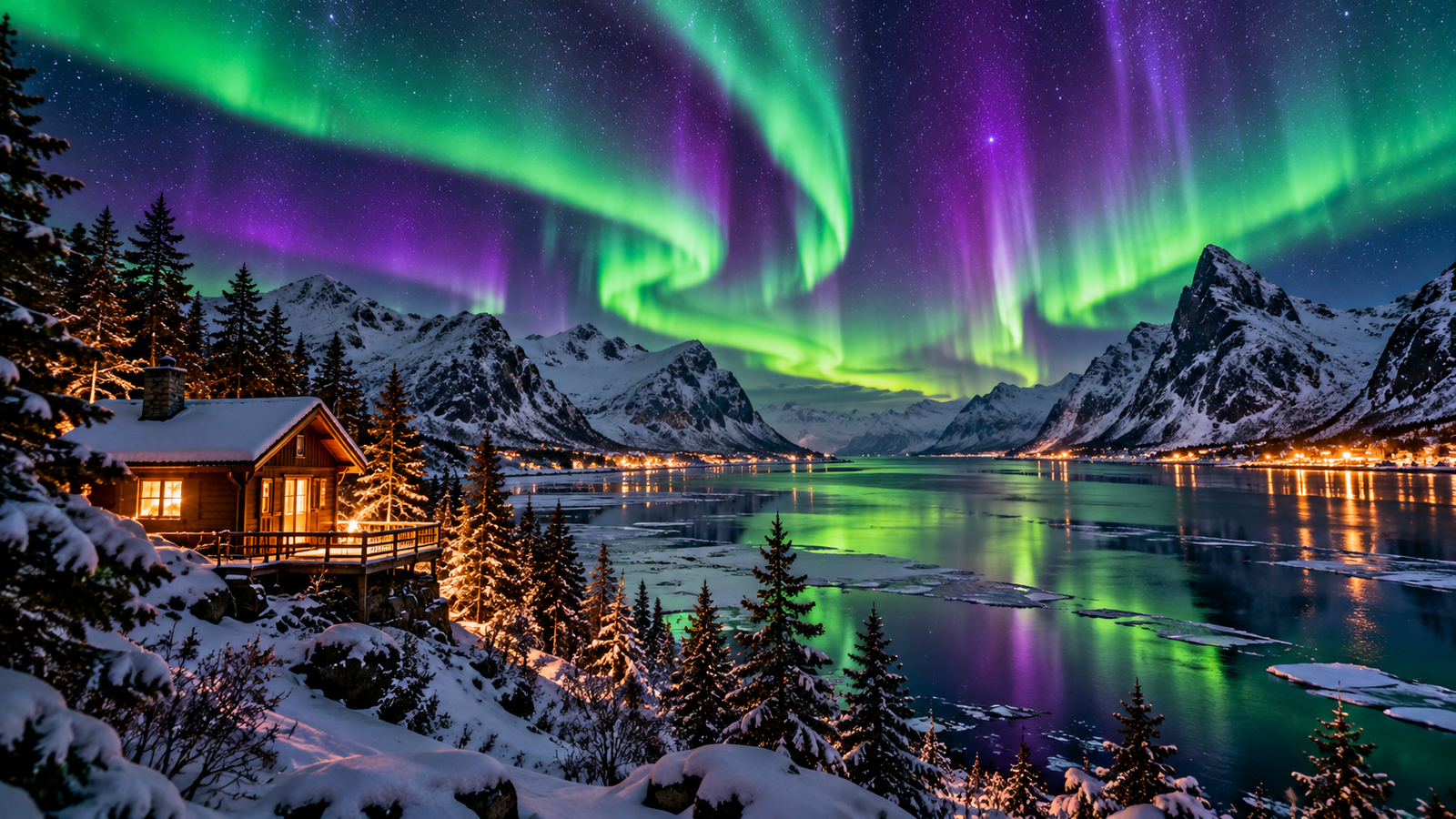
When these high-energy solar particles collide with gases in our upper atmosphere, the gas molecules become energized and release photons of light:
- Green Light: Oxygen molecules colliding roughly 100 kilometers above the ground (the most common and brightest aurora).
- Red and Violet Light: Higher-altitude oxygen and nitrogen interactions during intense geomagnetic storms.
The entire show is governed by the sun’s 11-year activity cycle. During periods of high solar activity—known as the Solar Maximum—the sun releases violent coronal mass ejections, creating massive geomagnetic storms that push the lights further south and make displays exponentially brighter and more dynamic.
The World’s Top Aurora Hubs
To give yourself the highest statistical probability of a sighting, you must travel into the Auroral Oval—an atmospheric belt located between 65° and 72° north latitude. Here are the world’s premier launchpads.
1. Tromsø, Norway (The Gold Standard)
Located nearly 350 kilometers north of the Arctic Circle, Tromsø is globally recognized as one of the Best Places to See Northern Lights.
- The Climate Advantage: Despite its extreme northern latitude, the coastal Gulf Stream keeps ocean waters ice-free and winter temperatures surprisingly mild compared to continental sub-zero extremes.
- The Infrastructure: Tromsø has its own international airport, reliable public bus transit, and dozens of budget hostels and self-catering apartments, allowing you to use a vibrant city as your base without paying remote resort surcharges.
2. Abisko, Sweden (The Cloud-Free Oasis)
If cloud cover is the primary enemy of aurora hunting, Abisko is the antidote.
- The Microclimate: Nestled in Swedish Lapland behind towering mountain peaks, Abisko benefits from a unique localized rain-shadow effect affectionately called the “Blue Hole of Abisko.”
- The Sky: Even when coastal areas in Norway and Sweden are socked in under dense cloud banks, the skies above Abisko frequently stay crystalline and clear, making it a statistically superior destination for sighting consistency.
3. Northern Iceland (Escaping the Capital Crowds)
While most tourists land in Reykjavik and take crowded bus tours around the Golden Circle, the smart move is heading north toward Akureyri and the Lake Mývatn region.
- The Edge: Northern Iceland experiences longer night hours, significantly less light pollution than the southern capital region, and puts you closer to the Arctic Circle.
Catching the Aurora Without Luxury Pricing
The travel industry makes its highest margins selling “packaged aurora experiences.” The secret to slashing your trip costs by 60% is understanding that you do not need an organized tour to look up at the night sky.
1. Rent a Car and Chase Your Own Skies
Commercial aurora tours often charge ₹10,000 to ₹18,000 per person per evening simply to drive you thirty kilometers out of the city in a 50-passenger bus.
- The Alternative: Rent an economy car equipped with studded winter tires. Monitor real-time cloud satellite maps from local meteorological agencies, pack a thermos of hot tea, drive away from city streetlights, and find a safe roadside layby. You control your schedule, stay warm inside your vehicle, and save thousands.
2. Choose Self-Catering Cabins Over Hotels
Dining out in Arctic Scandinavia or Iceland is notoriously expensive; a basic burger and fries can easily cost ₹2,500. Booking a modest holiday cabin or hostel with a communal kitchen allows you to buy groceries at local discount supermarkets, dramatically reducing your daily burn rate.
3. Watch the Sky From Your Own Doorstep
Luxury resorts charge fortunes for glass roofs because they claim you can watch from bed. Instead, book an affordable rural guesthouse twenty kilometers outside of major town centers. Step outside into the garden or driveway with warm boots, and you have the exact same view for free.
How to Maximize Your Sighting Odds
Seeing the Northern Lights requires aligning three separate variables: Darkness, Solar Energy, and Clear Skies. If any one of these three fails, you see nothing.
- Rule 1: Track the Kp-Index
Download dedicated free aurora monitoring apps like My Aurora Forecast or SpaceWeatherLive. The Kp-index measures geomagnetic activity on a scale from 0 to 9. A Kp of 2 or 3 is sufficient within the Arctic Circle; a Kp of 5 or higher indicates a major geomagnetic storm where auroras become fast, multi-colored, and visible across broad horizons. - Rule 2: Prioritize Cloud Cover Over Aurora Forecasts
A massive geomagnetic solar storm is completely useless if you are standing under two miles of thick maritime cloud cover. Always consult local satellite radar rather than general weather apps. Clear skies with a low Kp-index will yield a better visual experience than a raging storm behind cloud banks. - Rule 3: Give Yourself a 4-Night Window
Never book an Arctic trip for two nights expecting guaranteed results. Solar wind cycles fluctuate, and Arctic coastal weather changes by the hour. A minimum four-to-five-night stay gives you the buffer needed to wait out bad weather systems.
Frequently Asked Questions (FAQs)
Q: Do the Northern Lights look as vibrant to the human eye as in photos?
A: Camera sensors collect light over seconds, revealing electric greens, magentas, and deep purples that the human eye cannot fully process in the dark. To the naked eye, faint auroras often appear as glowing, milky-white or pale-green clouds. However, during strong geomagnetic storms, the lights become intensely green, visibly ripple across the sky, and require zero camera assistance to inspire awe.
Q: What is the cheapest month to see the lights?
A: Late September to October and March to early April are excellent shoulder periods. Temperatures are significantly milder than the brutal January freezes, skies are often clearer, flights are cheaper, and strong auroral activity frequently spikes around the autumn and spring equinoxes due to geomagnetic alignment (the Russell-McPherron effect).
Q: What clothing is non-negotiable for aurora watching?
A: You will be standing stationary in sub-zero temperatures for hours. Invest in high-grade thermal wool base layers, windproof outer shells, and crucially, insulated winter boots with thick soles to prevent ground freeze from chilling your feet. Chemical hand and toe warmers are essential lifesavers.
The Universe on Display
There are few moments in human life that completely dissolve our sense of self-importance.
Standing in the absolute silence of the Arctic night, watching ribbons of emerald light pulse across stars that have burned for billions of years, is one of them. It is a humbling, breathtaking reminder of the cosmic dance our planet performs every single second.
You do not need millions in the bank or a champagne glass in hand to claim that moment. You just need warm wool socks, a clear patch of northern sky, and the patience to look up.
The greatest show in the universe is free. Go claim your front-row seat.