Smart Ring vs Smartwatch: Which Wearable is Best for You?
It is 10:00 PM. You are lying in bed, trying to wind down.
Suddenly, your wrist vibrates. It’s an email from a colleague, or maybe a notification that someone liked your photo. The screen glows bright blue, washing your dark room in artificial light. You check it. Your heart rate goes up. Your natural sleep hormone, melatonin, drops. Your boundary between “work” and “life” is broken once again.
This is the hidden cost of the Smartwatch.
What began as a revolutionary tool to keep us connected has slowly turned into a leash. We are tired of the constant buzzing, the daily charging anxiety, and the glowing screens that demand our attention every five minutes.
This fatigue has birthed a massive counter-movement in the wearable industry: The Smart Ring.
From Silicon Valley executives to professional athletes, people are quietly sliding their smartwatches off their wrists and replacing them with a simple, screen-free band of titanium on their fingers. But is this just a passing design fad, or is “invisible tech” the actual future of health tracking?
Let’s look at the science, the usability, and the daily reality of the Smart Ring vs Smartwatch debate to see which one actually deserves a place on your body.
What is a Smart Ring?
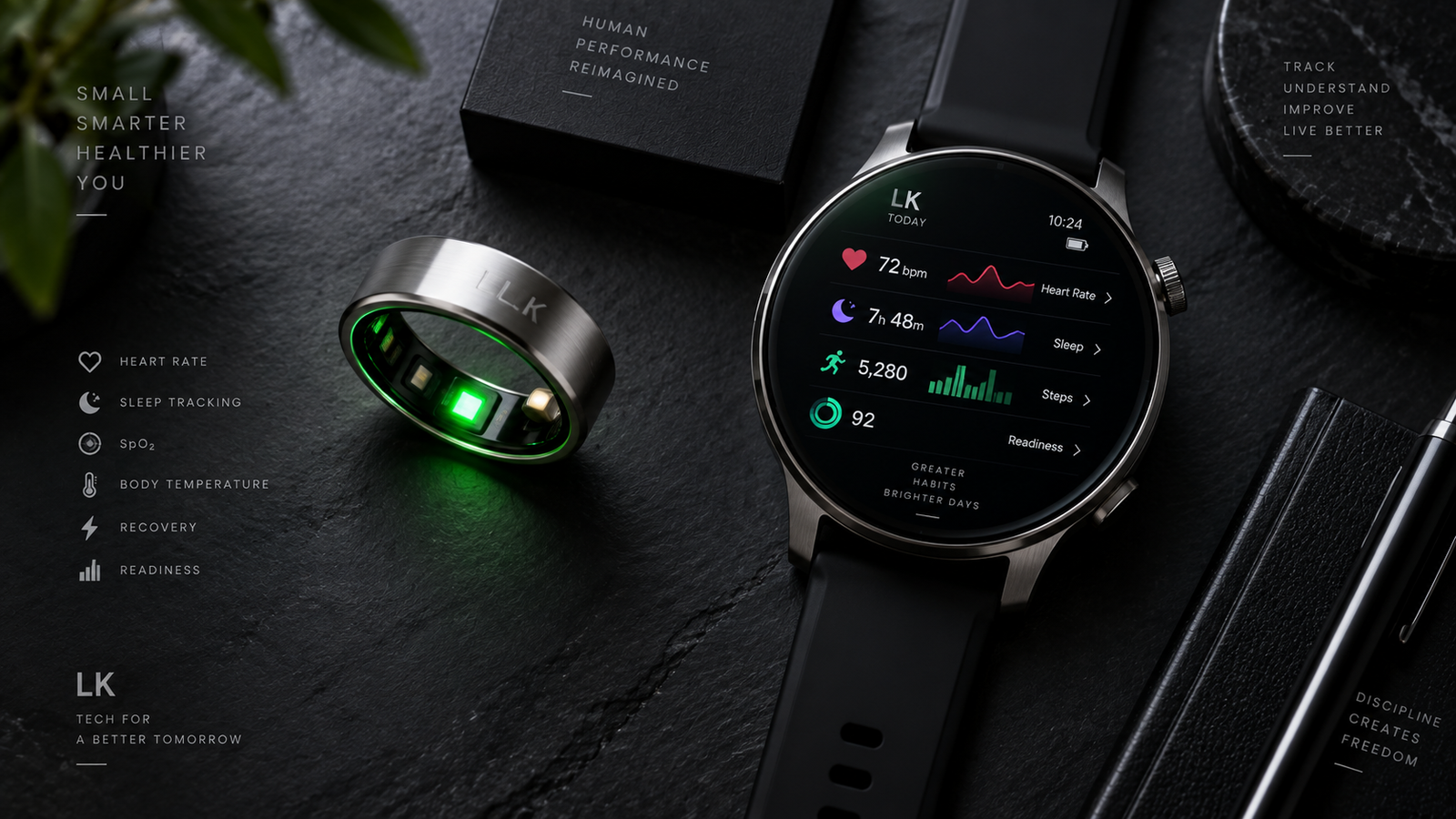
On the surface, a smart ring looks like a standard piece of jewelry—perhaps a slightly thicker wedding band made of titanium or ceramic. But on the inside, it is a marvel of micro-engineering.
The inner band of a smart ring is packed with red, green, and infrared LED sensors, temperature sensors, and accelerators. Because the skin on your fingers is much thinner than the skin on your wrist, and the blood vessels (capillaries) are much closer to the surface, a smart ring actually has a clearer biological signal than a smartwatch.
It doesn’t have a screen. It doesn’t have a speaker. It doesn’t vibrate. It is designed to be completely passive. It sits on your hand, silently recording your heart rate, skin temperature, sleep quality, and blood oxygen levels, and syncs that data to your phone once or twice a day. It is technology that gets out of your way.
Why People Are Ditching the Wrist
The primary reason behind the massive interest in the Smart Ring vs Smartwatch comparison is Mental Peace.
When you wear a smartwatch, you are essentially wearing a miniature smartphone on your wrist. It is a constant source of “Micro-Distractions.” Every vibration is a demand on your focus. It encourages “quick scrolling” and keeps you hooked into the digital loop.
A smart ring offers a “Digital Sanctuary.”
- The Sleep Win: Because there is no screen, you can wear it to bed without the fear of accidental light flashes. Furthermore, sleeping with a thick, heavy smartwatch on your wrist is uncomfortable; a lightweight, 3-gram titanium ring is completely imperceptible.
- The Battery Win: A smartwatch (like the Apple Watch) typically lasts 18 to 36 hours before needing a charge. This creates “charging anxiety.” A smart ring, because it has no display to power, easily lasts 5 to 7 days on a single charge. You only have to think about charging it once a week.
Comparing the Two Giants of Wearable Tech
Let’s be objective. The smart ring is not a perfect replacement for the smartwatch; it is a different tool for a different job.
Where the Smartwatch Still Wins:
- Workout Tracking (Real-Time Data): If you are a runner, a cyclist, or an athlete, you need to see your heart rate, your distance, and your pace while you are moving. A smart ring cannot show you this data in real-time because it has no screen. You have to wait until you check your phone.
- Navigation and Convenience: Having Google Maps show you directions on your wrist while riding a bike or walking is incredibly useful. So is the ability to answer a quick call when your hands are full.
- Active Payments: While some smart rings support NFC payments (tap-to-pay), doing it with a smartwatch screen is currently much more intuitive and widely supported.
Where the Smart Ring Wins:
- Sleep Analysis: Because of the proximity of blood vessels in the fingers, smart rings are widely considered the most accurate consumer sleep trackers on the market. They track your REM, Deep, and Light sleep phases with medical-grade precision.
- Style and Versatility: A smartwatch looks sporty or techy; it doesn’t always fit with a formal suit or elegant evening wear. A titanium smart ring is timeless. It looks like a piece of high-end jewelry, blending seamlessly into any dress code.
- Durability: No glass screen means nothing to crack. You can drop a smart ring, scrape it against a barbell at the gym, or wear it while washing dishes without worrying about shattering a ₹40,000 display.
How to Choose Your Next Wearable
To decide on your side of the Smart Ring vs Smartwatch debate, you must ask yourself one question: “Do I want to manage my day, or do I want to track my life?”
- Choose the Smartwatch if: You are an active runner, you need turn-by-turn navigation on your wrist, you want to reply to messages on the go, and you don’t mind charging your device every night.
- Choose the Smart Ring if: You suffer from notification fatigue, your primary goal is sleep and recovery tracking, you want to wear classic analog watches (like our favorite Casio!) without looking like you have two watches on, and you want a battery that lasts all week.
Frequently Asked Questions (FAQs)
Q: Do smart rings require a monthly subscription?
A: This is a major factor to check before buying. Some brands (like Oura) require a monthly subscription fee (around $6/month) to unlock your full health data. Other brands (like Ultrahuman or Samsung) offer all features for free once you buy the ring.
Q: How do I know my ring size?
A: You cannot just guess. Because our fingers swell during the day and in the heat, companies will send you a physical “Sizing Kit” of plastic rings first. You must wear the plastic ring for 24 hours to find the perfect fit before they ship the actual titanium device.
Q: Can I wear a smart ring while lifting weights?
A: Yes, but be careful. While the titanium is tough, knurled metal barbells can scratch the outer coating over time. Many weightlifters prefer to wear their ring on their non-dominant hand or use silicon covers during heavy workouts.
The Era of “Invisible” Technology
The trend is clear.
We have spent the last fifteen years making screens larger, brighter, and more prominent in our lives. We have filled our pockets, our desks, and our walls with glass.
But we have reached the limit of our attention.
The Smart Ring vs Smartwatch debate is the beginning of the “Invisible Tech” era. We are starting to demand technology that serves us in the background—gathering data, protecting our health, and keeping us safe without asking for our constant attention.
If you want to stay connected to the digital matrix, keep the smartwatch. But if you want to reconnect with the physical world while keeping a silent, powerful guardian on your health?
It’s time to put a ring on it.