Why and How Active Noise Cancellation Changes Your Hearing
You slide the headphones over your ears. You hit the switch.
Instantly, the roaring engine of the airplane, the hum of the office air conditioner, and the distant chatter of the coffee shop vanish. It feels like you’ve been submerged in a pool of warm oil. The world is gone, replaced by a quiet, pristine sanctuary of absolute silence.
It feels like magic. But biologically and physically, your ears are experiencing something very different from “nothing.”
In the modern world, Active Noise Cancellation (ANC) has gone from a premium luxury for pilots to an everyday necessity for millions of commuters, students, and remote workers. We wear them for eight hours a day to build our “focus cocoons.”
But how does that silence actually get made? Why does your brain feel a weird “pressure” the moment you turn it on? And is this artificial silence silently rewiring how your ears process sound? Let’s look behind the speaker grill to find out.
The Physics of Silence
To understand why and how Active Noise Cancellation impacts your ears, we first have to bust a massive myth: Your ANC headphones do not “block” sound. They actually create more of it.
Sound is a wave. It has peaks (high pressure) and troughs (low pressure) traveling through the air. When those waves hit your eardrum, they vibrate, and your brain translates those vibrations into “noise.”
The Principle of Destructive Interference:
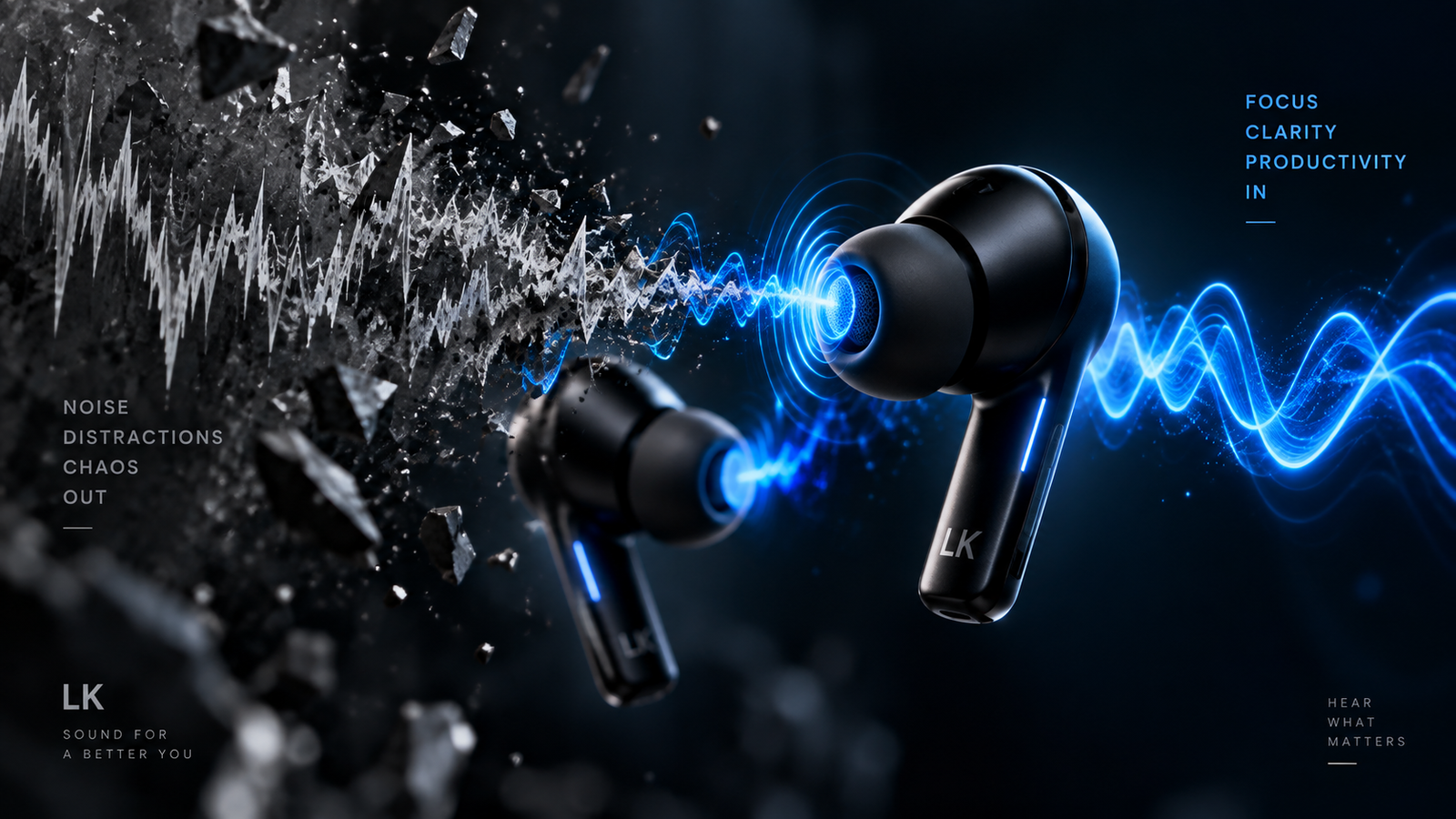
Your ANC headphones have tiny microphones on the outside. These microphones listen to the ambient noise of your environment (like the hum of a jet engine).
- The Calculation: The internal computer chip instantly analyzes that sound wave.
- The Counter-Attack: The headphone speakers generate a completely new sound wave that is the exact mirror image of the noise—the peaks of the new wave match the troughs of the old wave.
When these two waves collide inside your ear canal, they cancel each other out. This is “Phase Cancellation.” The net result is a flat line—silence. You aren’t hearing “no sound”; you are hearing two opposite sounds destroying each other on your eardrum.
The Ear Pressure Illusion: Why Your Brain Thinks You Are Underwater
The moment you toggle ANC on, you likely feel a strange, heavy sensation in your ears. It feels exactly like the pressure change you get when a plane takes off or when you dive into a deep swimming pool.
The False Alarm of the Eardrum
This “ear pressure” is actually a psychological illusion.
When the headphones cancel out the low-frequency background rumbles of the world, your inner ear suddenly has a mismatch.
- The Conflict: Your eyes tell your brain you are sitting in a normal room. But your ears are reporting a level of absolute silence that physically does not exist in nature unless there is a massive change in atmospheric pressure.
- The Response: Your brain gets confused. It assumes the pressure in your cabin has dropped, and it triggers the “Acoustic Reflex,” making you feel like you need to pop your ears. There is no actual physical pressure on your eardrum; your brain is just misinterpreting the unnatural silence.
Why and How ANC is Changing Your Hearing Habits
While Active Noise Cancellation is safe in moderation, using it as a “permanent shield” for eight hours a day is causing a silent shift in our auditory health.
1. The “Auditory Fatigue” Trap
Even though you hear “silence,” the speakers in your earbuds are still constantly vibrating to create those anti-noise waves. Your eardrum and the tiny hair cells inside your cochlea are still physically working to process these competing frequencies. This can lead to “Auditory Fatigue”—a state where your ears feel tired, heavy, or ringing (tinnitus) even though you haven’t listened to loud music.
2. The Danger of “Isolation Addiction”
When you live in a constant state of artificial silence, your brain’s “volume knob” (the auditory cortex) adjusts. It becomes hyper-sensitive.
When you finally take the headphones off, normal sounds—like a dropped spoon, a dog barking, or a car horn—can feel painfully loud and jarring. You are accidentally training your brain to become less resilient to the real world.
How to Use Noise Cancellation Responsibly
You don’t need to throw away your AirPods or Bose headphones. They are incredible tools for focus. You just need to practice “Acoustic Hygiene.”
1. The 2-Hour Rule
Never keep ANC on continuously for more than two hours. Every 120 minutes, take the headphones off for at least ten minutes. Let your ears “breath” and adjust back to the natural ambient sounds of your environment.
2. Turn on “Transparency Mode” When Moving
If you are walking on the street, running, or cycling, turn ANC off. Your brain relies on spatial audio cues (hearing a car coming from behind) to keep you safe. “Total isolation” in a public space is a physical hazard.
3. Choose Over-Ear Over In-Ear
If you use ANC daily for work, invest in over-ear headphones rather than in-ear buds. Over-ear headphones provide natural, physical sound isolation (passive cancellation), meaning the electronic system doesn’t have to work as hard (generating fewer anti-noise waves) to keep you in silence.
Frequently Asked Questions (FAQs)
Q: Does Active Noise Cancellation prevent hearing loss?
A: Yes, in a roundabout way. Because ANC blocks out the background noise of the metro or the office, you don’t have to crank up the volume of your music to drown out the world. By keeping your music at a lower, safer volume, you are protecting your ears from long-term damage.
Q: Can ANC cause Tinnitus (ringing in the ears)?
A: ANC itself does not cause tinnitus. However, if you already have mild, unnoticeive tinnitus, the absolute silence of ANC can make that ringing sound much more prominent and annoying because there is no background noise to mask it.
Q: Why do cheap ANC headphones make me feel dizzy?
A: Cheap processors have a slight “delay” in generating the anti-noise wave. This slight lag creates a mismatch between your visual and auditory systems, which your brain translates as motion sickness or dizziness. Stick to reputable brands with fast processors.
The Premium Cost of Peace
Silence used to be free. Today, it is a premium product.
Active Noise Cancellation is one of the greatest engineering feats of the modern age. It allows us to reclaim our focus in a world that is getting louder every day. But remember: your ears were designed to listen to the world, not to a continuous wave of artificial anti-noise.
Use the technology to find your focus. Use it to survive the flight. But when the work is done, take the buds out.
Listen to the birds. Listen to the rain. Let your ears remember what real silence sounds like.