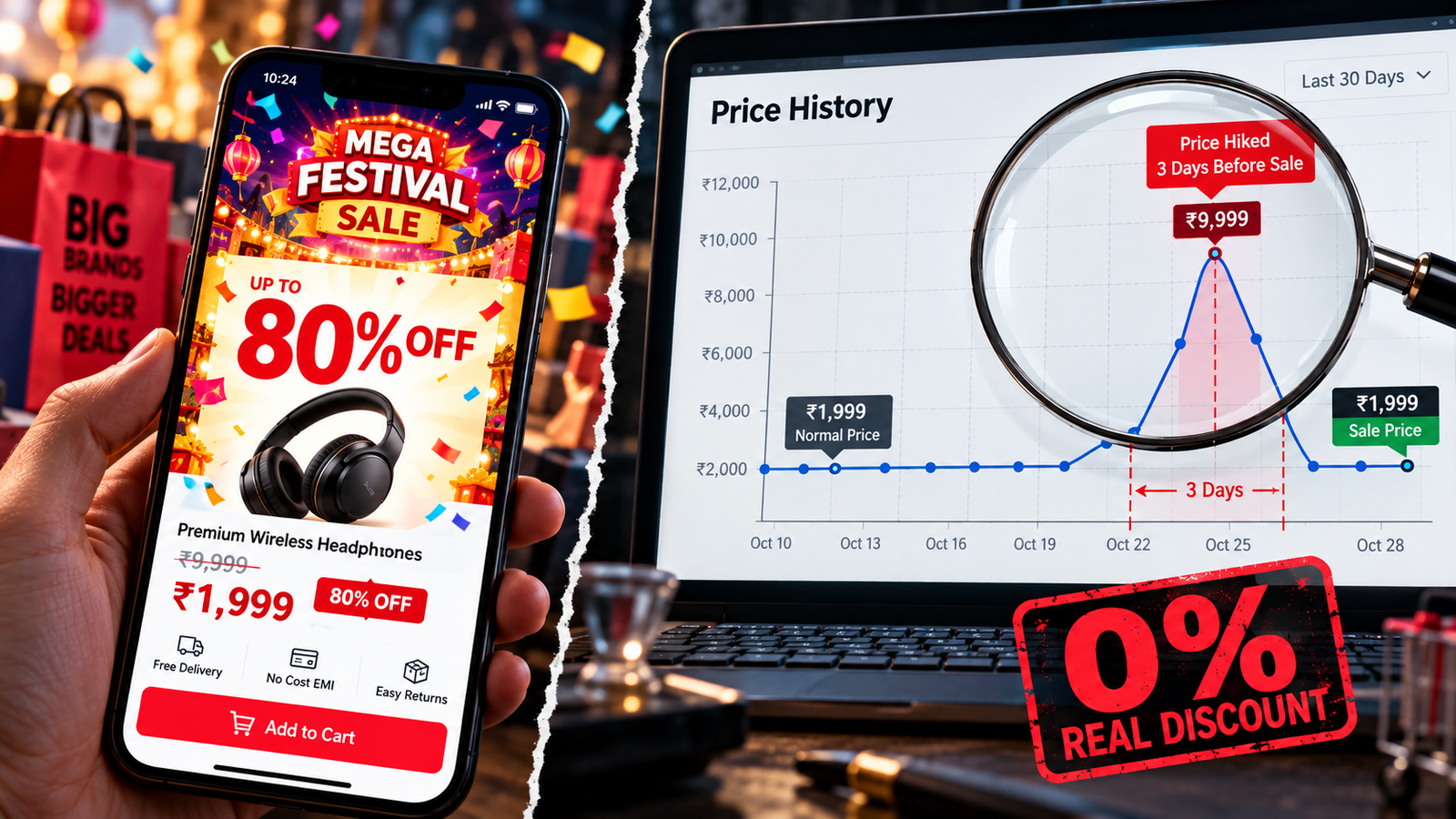
The Festive Sale Deals Trap: How Fake Discounts Trick You
It is midnight. Your phone screen is glowing in the dark, bathed in festive red and gold banners.
Confetti bursts across your display. Bold yellow lettering screams: “80% OFF — Lightning Deal Ends in 04:59!”
You see a 55-inch 4K smart TV marked down from an eye-watering ₹85,000 to just ₹32,999. You feel your adrenaline spike. Your brain calculates the numbers in a flash. You think, “I am saving over ₹50,000 right now. If I don’t click ‘Buy Now’ in the next thirty seconds, someone else will grab it.”
You swipe your card. You go to sleep feeling like an absolute financial genius who just outsmarted the system.
Except you didn’t.
If you tracked that exact same TV two weeks ago, you would discover a dirty retail secret: it was selling for ₹31,999 on a quiet Tuesday afternoon. The massive ₹85,000 “original price” was an artificially inflated anchor, the countdown timer was an automated psychological trigger, and your “exclusive festive discount” actually cost you a thousand rupees more than regular market price.
Welcome to the mechanics of modern e-commerce. As festival sales take over our screens, understanding how Festive Sale Deals are engineered is the only way to protect your hard-earned money. Here is how the digital marketplace manipulates your brain, and the exact toolkit you need to beat the algorithm at its own game.
The Price Anchor Trick: How Old Stock Becomes a “Steal” in Festive Sale Deals
To understand how retail giants engineer discounts, you must understand a basic rule of behavioral economics: Humans do not know what things are worth.
We do not evaluate the price of an item in a vacuum. We evaluate it relative to a reference point—a baseline known as the Price Anchor.
[ Normal Days ] Product Price: ₹2,000 ─────────────> You Ignore It
[ 5 Days Before ] Price Jacked Up to: ₹3,999 ───────> Artificial Anchor Set
[ Sale Day ] Marked Down to: ₹2,199 (45% OFF!) ─> You Rush to Buy
Retailers exploit this by systematically bumping up the listed “Maximum Retail Price” (MRP) or crossing out an exaggerated list price days before a major sale event.
- A pair of wireless earbuds that sells all year for ₹1,499 suddenly gets listed with a crossed-out MRP of ₹4,999.
- The sale page proudly slaps a bright green badge: “70% PRICE DROP!”
- The consumer’s brain fixates entirely on the ₹3,500 “savings” rather than evaluating whether the earbuds are worth the ₹1,499 cash leaving their bank account.
You aren’t buying a discount. You are buying a dopamine hit manufactured by a digital price tag.
The Panic Machine: Dark Patterns and Manufactured Scarcity
Have you ever wondered why festival sale pages feel so chaotic? Why there are flashing countdown clocks, vibrating stock meters, and pop-up notifications telling you that “14 people in your city bought this in the last 10 minutes”?
In user experience (UX) design, these are called Dark Patterns.
They are deliberate architectural choices designed to trigger FOMO (Fear Of Missing Out) and bypass your analytical thinking. When your brain is subjected to artificial time limits, it shifts from logical evaluation to survival mode.
You stop asking essential questions:
- Do I actually need a new air fryer?
- Do I have space in my kitchen for this?
- Is this an older model that won’t receive software updates?
Instead, you focus exclusively on securing the transaction before the timer hits zero. The platforms know that if you close the app and think about the purchase for twelve hours, there is an 80% chance you will realize you don’t need it and abandon the cart. The urgency is not about limited stock; it is about eliminating your hesitation.
Convenience Fees and Bank Offer Math
The headline discount on the search banner is rarely the price you pay at the final payment gateway. Modern platforms have perfected the art of recouping discounts through micro-charges and complex card terms.
1. The Hidden Surcharges
Next time you reach the final payment screen, expand the bill breakdown carefully:
- Secured Packaging Fee: ₹49 to ₹99 added automatically.
- Convenience / Platform Fee: An unavoidable ₹15 to ₹50 per order.
- Handling Charges on Heavy Appliances: Often added silently at checkout.
These micro-fees sound small on an individual purchase, but across millions of daily orders during festive weeks, they generate hundreds of crores for platforms while quietly eating into your perceived savings.
2. The Bank Cashback Maze
That flashing banner promising “Instant ₹5,000 Off on Credit Cards” comes with a mountain of conditions:
- It applies only to specific non-EMI transactions on select bank variants.
- It requires a minimum cart value that forces you to add unnecessary items just to qualify.
- If you opt for an installment option, the processing fees and GST on interest often wipe out the entire upfront discount value.
The Buyer’s Defense Protocol: How to Spot Genuine Deals
You do not have to boycott festive shopping entirely. Genuine, aggressive bargains do exist—especially on older inventory, last-generation smartphones, and clearance electronics. The key is separating real price drops from algorithmic theater.
HOW TO AUDIT A SALE DEAL
│
Copy Product Link from Sale Page
│
▼
Paste into a Price History Tracker
│
┌─────────────────┴─────────────────┐
▼ ▼
Price Was Cheaper 30 Current Price is Lowest
Days Ago? (FAKE) in 180 Days? (REAL)
│ │
▼ ▼
Skip the Deal Apply Bank Offer & Buy
1. Use Independent Price Trackers
Never trust the crossed-out price on the seller’s product page. Before hitting checkout on any high-value item, copy the product URL and paste it into independent price history tracking tools like Keepa (for Amazon) or PriceBefore / BuyHatke (for Indian marketplaces).
These free tools plot the item’s historical price across the past 365 days on a clean graph:
- If the graph shows the item dropped to its lowest point in six months, you have found a real deal.
- If the graph shows a sudden, sharp price spike three days before the sale followed by a “discount,” you are looking at an engineered trap.
2. Beware of “Special Edition” Model Numbers
Major electronics brands frequently manufacture specific sub-variants of televisions, washing machines, and laptops exclusively for festival sales.
- A TV model might have an almost identical name to a flagship unit, but with one letter altered in the serial number (e.g., changing XYZ-8500 to XYZ-8500-F).
- These festival-specific units often cut subtle corners: fewer HDMI ports, lower-grade speaker drivers, or cheaper plastic casing to hit an aggressive price point while mimicking a high-end model.
3. Master the “Open Box Delivery” Process
For electronics and smartphones, always verify if your order comes with Open Box Delivery.
- Do not share the delivery OTP with the agent until they have physically opened the outer package in front of you.
- Inspect the seal on the internal gadget box, verify the IMEI or serial number matches your invoice, and ensure there is no physical damage.
- If the courier refuses to open the box before taking the OTP, decline the delivery immediately.
Frequently Asked Questions (FAQs)
Q: Are festive discounts completely fake on every product?
A: No. High-volume categories like previous-generation smartphones, seasonal apparel, and slow-moving home appliances often see genuine price drops of 15% to 30% as brands clear warehouse inventory before year-end. The trick is verifying the item’s 90-day price history rather than trusting the promotional banner.
Q: Why do prices change multiple times during the same sale day?
A: E-commerce platforms use dynamic pricing algorithms that adjust item costs in real time based on user traffic, cart additions, competitor pricing, and remaining hourly inventory quotas. A product might cost more at 8 PM when millions are browsing than at 6 AM.
Q: What should I do if a seller cancels my discounted order?
A: File a formal grievance through the National Consumer Helpline (NCH) portal or app with screenshots of your confirmed order and invoice. E-commerce rules mandate that sellers cannot arbitrarily cancel confirmed consumer orders without valid, verifiable logistics reasons.
Shop the Product, Not the Percentage
A markdown is only a saving if you had already budgeted for the item before the sale started.
If you spend ₹10,000 on a luxury jacket you never intended to buy simply because it was marked down by 60%, you didn’t save ₹15,000—you lost ₹10,000.
The platforms spend billions engineering environments to make you feel rushed, excited, and competitive. Step out of the psychological arena. Use price tracking tools, ignore countdown clocks, check the final invoice fees, and remember the golden rule of smart shopping:
The greatest discount in the world will always be 100% off—achieved simply by closing the tab and walking away.