The Dopamine Menu For Ultimate Productivity Hack
Let’s play a quick game of psychological honesty.
It’s the middle of the afternoon. You have a massive report to write, or a complicated project to review. You open your to-do list. It stares back at you with thirty cold, demanding bullet points: Fix bug, email client, organize files, finish strategy deck.
Instantly, a wave of mental fatigue hits you. Your brain whispers, “This is too hard. Let’s just check Instagram for two minutes to clear our heads.”
Two hours later, you are knee-deep in a rabbit hole of random videos, wondering where your afternoon went. You didn’t rest; you just numbed your brain. And now, you feel worse than before.
Traditional to-do lists are built for robots. They assume humans are machines that can just flip a switch from “Rest” to “Maximum Output.” But human brains run on chemistry—specifically, dopamine, the neurotransmitter of motivation and reward.
When your brain is depleted, a boring to-do list looks like a mountain. You don’t need another list of chores. You need a Dopamine Menu. Originating from clinical psychology and popularized by high-performers, this simple visual framework changes how you manage your energy, defeats procrastination, and cures doom-scrolling for good.
The Chemistry of Cravings: Why Traditional Lists Fail Us
To understand why a Dopamine Menu works, you have to look at what happens when you procrastinate.
Procrastination isn’t a failure of character; it’s a failure of emotional regulation. When a task on your list feels intimidating, boring, or confusing, your brain experiences a mini-threat response. It seeks comfort to escape that discomfort. Where does it look? Straight to the nearest pocket-sized casino: your smartphone.
Your phone offers “Cheap Dopamine.” It requires zero effort and gives an instant reward.
Deep work, on the other hand, offers “Expensive Dopamine.” It requires hours of struggle for a reward that only comes later.
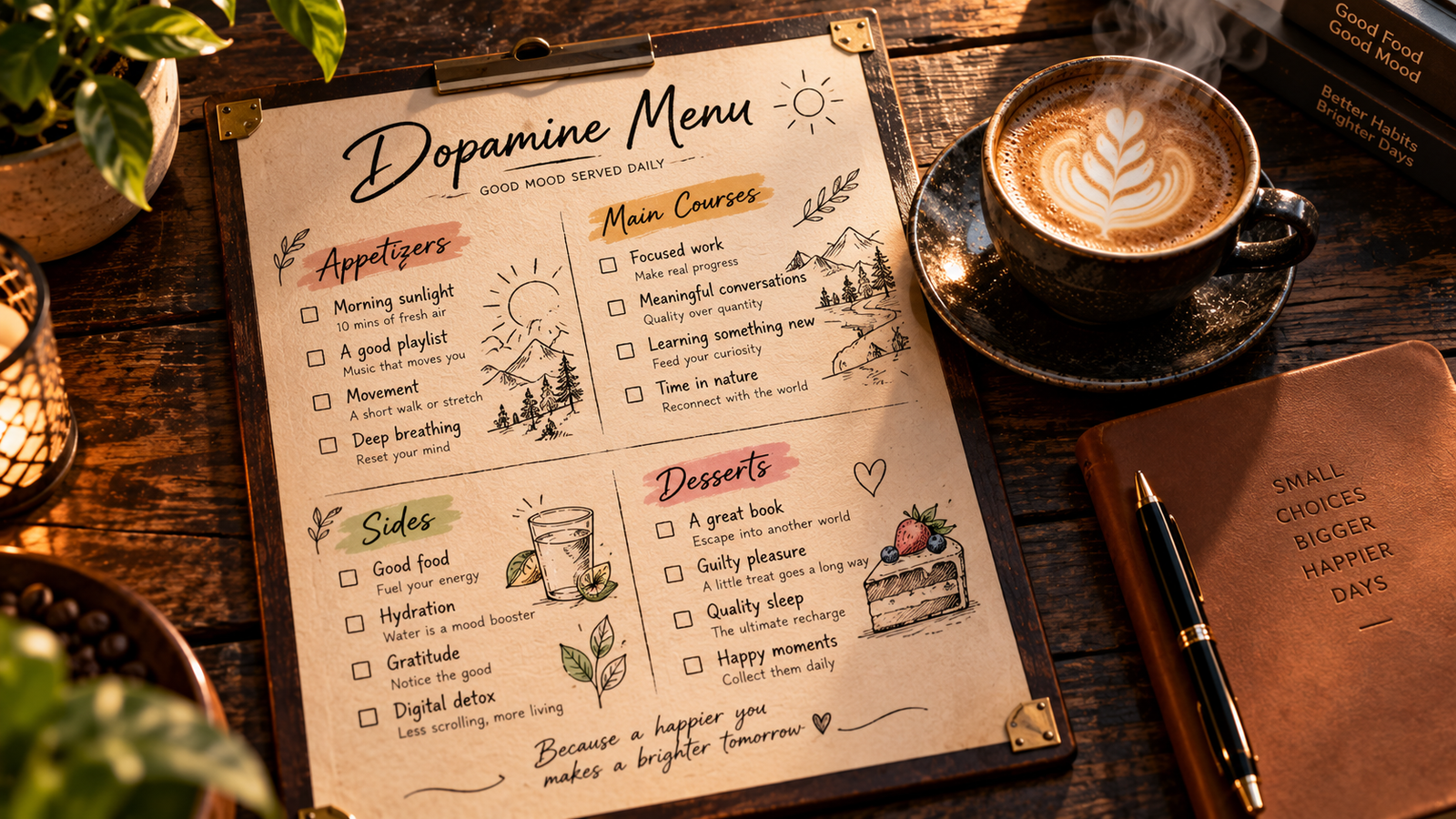
A standard to-do list just highlights the struggle. It tells you what to do, but it gives your brain zero emotional fuel to do it. A Dopamine Menu, however, recognizes that your brain needs healthy fuel to function. It categorizes your tasks and rewards like a restaurant menu, giving you options based on your current “hunger” levels.
Building Your Personal Plate: Appetizers, Mains, and Desserts
To create your menu, grab a blank piece of paper or open a notes app. Divide it into four distinct sections. You are the chef, and your brain is the customer.
1. Appetizers (Quick, Low-Effort Hits)
These are tiny, 2-to-5-minute activities that give you a quick, healthy burst of dopamine and wake up your nervous system. They are designed to transition you from “lazy” to “active.”
- Examples: Drink a glass of ice-cold water, do 10 jumping jacks, stretch your shoulders, water a plant, clear three old emails.
- When to use: When you are staring at your screen paralyzed and can’t bring yourself to start anything big.
2. Main Courses (Deep Work & Heavy Lifting)
These are your big, high-value tasks. They take real cognitive energy, time, and focus. They are the things that actually move the needle in your career or life.
- Examples: Writing a core report, coding a feature, designing a presentation, studying a complex chapter.
- When to use: Only when your energy levels are peaking (usually mornings), and you’ve warmed up your brain with an Appetizer.
3. Sides (Bonus Habits & Maintenance)
These are pleasant, supporting activities that you can do while doing something else, or use to pad out your day with positive momentum.
- Examples: Listening to an educational podcast while walking, organizing your desk while waiting for a download, brewing a nice cup of herbal tea.
- When to use: To keep your hands busy or make boring chores feel slightly more luxurious.
4. Desserts (Guilt-Free Rewards)
This is the secret weapon of the menu. Traditional productivity culture tells you: “No fun until the work is done!” That is a recipe for burnout. A Dopamine Menu explicitly carves out space for guilty pleasures—on your terms.
- Examples: 20 minutes of guilt-free gaming, watching an episode of your favorite show, scrolling social media for 15 minutes, eating a piece of dark chocolate.
- When to use: Only after you have completed a Main Course. You don’t scroll to escape work; you scroll because you earned your Dessert.
How to Use Your Menu in Real-Time
Having a menu on your desk is useless if you don’t know how to order from it.
When you feel that familiar afternoon slump creeping in, or you catch yourself reaching for your phone out of pure boredom, stop. Treat yourself like a customer at a cafe. Look at your paper menu and ask: “What kind of hunger do I have right now?”
- If you’re too exhausted for a Main Course, don’t force it. Order an Appetizer. Do 10 pushups or clear your Downloads folder. Often, that tiny micro-win is enough to clear the mental fog and transition you naturally into a Main Course.
- If you just crushed a massive report, claim your Dessert. Set a timer for 15 minutes of social media, and when the timer rings, close the app. Because you framed it as a “Dessert” rather than a “secret addiction,” you remove the shame and the doom-scrolling spiral.
Frequently Asked Questions (FAQs)
Q: Is a Dopamine Menu just a to-do list with fancy names?
A: No. A to-do list tells you obligations. A Dopamine Menu gives you options. It acknowledges that your energy fluctuates throughout the day, and gives you healthy ways to manage your brain chemistry instead of relying on mindless scrolling.
Q: Can I put unhealthy habits on my Dessert menu?
A: Keep your Desserts healthy or controlled. If your “Dessert” is eating an entire tub of ice cream or smoking a cigarette, it will crash your energy. Stick to high-joy, low-destruction rewards like gaming, reading fiction, or a sweet treat in moderation.
Q: How often should I update my Dopamine Menu?**
A: Every few weeks. What gives you a dopamine hit in January might feel boring by March. Keep your menu fresh by swapping out appetizers and desserts that no longer excite you.
Take Back the Kitchen
Your attention is the most valuable commodity on the planet. Tech companies spend billions of dollars hiring neuroscientists to steal it from you every time you unlock your phone.
By building a Dopamine Menu, you take back the control panel of your mind. You stop being a passive consumer of cheap algorithmic entertainment and become the active designer of your own joy and productivity.
The kitchen is yours. What are you going to order today?